The shortlist
Softr, Glide and Airtable come first on this shortlist for founders who need a working app with data, logins and workflows and have no engineers on the team. It is written for non-technical founders and startup teams building a first product or an internal system. Zoho Creator and Quickbase follow as broader platforms with more to configure.
Tool details

#1 · Softr
Softr
Client portals and internal tools built from a plain-language description
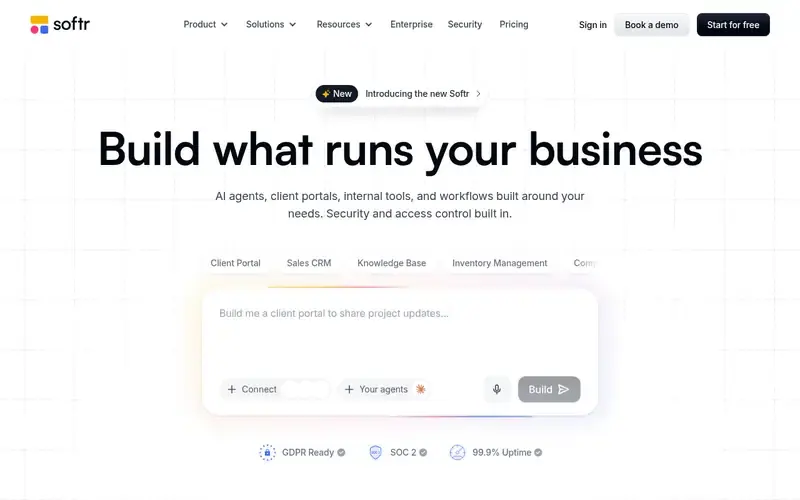
Softr is an AI app builder for creating portals and internal tools for business operations without code. You describe the app and its AI Co-Builder generates the database, pages, user roles and business logic.
Documented strengths
- AI Co-Builder generates database, pages, user roles and business logic
- Native database, plus connections to more than 21 external data sources
- Role-based access that can be previewed as a specific role or user before publishing
- Managed hosting with stated 99.9% uptime, backups and 24/7 monitoring
- Workflows can call any external API over HTTP
Documented limits
Documented for portals and internal tools for business operations, with typical builds such as CRMs, intranets, trackers, forms and dashboards. Founders planning a different kind of product should check the vendor documentation.
- Who it is for
- Client portals and internal tools built from a plain-language description
- Platforms
- Vendor-managed hosting; apps built and edited visually, or described in Softr, Claude or ChatGPT
- Pricing
- See the vendor's own pricing page for current plans and costs. softr.io
- Facts checked
- 21 November 2026
Why it made the list: It sits first because the vendor documents generating data, pages, roles and logic from a description, which covers the pieces a first app needs.

#2 · Glide
Glide
Teams whose data already lives in spreadsheets
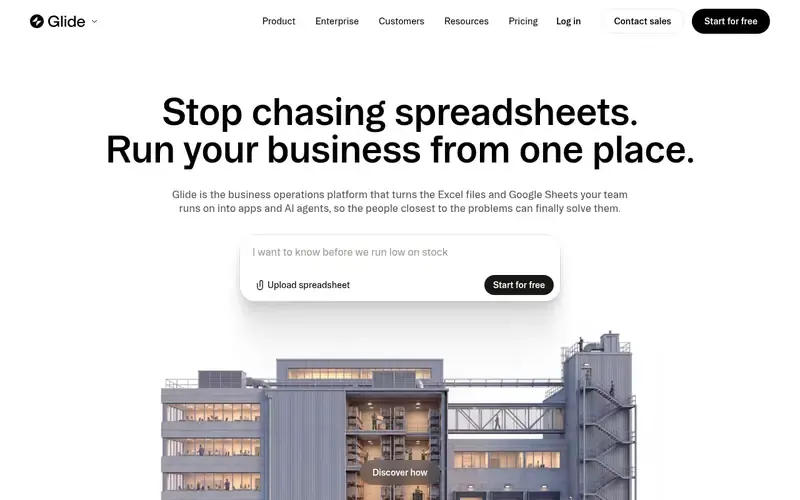
Glide is a business operations platform that turns Excel and Google Sheets data into internal apps and AI agents. Its agent builds a working app for desktop and phone from the loaded data.
Documented strengths
- SheetSense analyzes an uploaded spreadsheet, including formulas and lookups
- Apps for desktop and phone, with a marketplace of customizable templates
- Apps private to the company by default, with granular permissions and SSO
- Connects to Google Sheets, Airtable, Excel and SQL
- Audit log of builds, changes and publishes
Documented limits
Documented around spreadsheet-based and connected-data apps such as forms, portals, dashboards, internal tools and mobile field apps. Teams that need a different app type should check the vendor documentation.
- Who it is for
- Teams whose data already lives in spreadsheets
- Platforms
- Desktop and phone apps; hosted on Google Cloud Platform with servers in Iowa, USA
- Pricing
- See the vendor's own pricing page for current plans and costs. glideapps.com
- Facts checked
- 21 November 2026
Why it made the list: It follows Softr because teams that already keep their data in a spreadsheet can start from that file instead of from a blank data model.

#3 · Airtable Inc.
Airtable
Data-heavy products that need a shared relational base
Airtable is a no-code platform for building AI-powered workflows, apps and agents on a shared relational data foundation. Apps can be generated through conversational building with no-code components.
Documented strengths
- Conversational app building with no-code components
- One relational source of truth for apps, agents and workflows
- Admin roles and fine-grained role-based access control
- Data reachable from Slack, Claude, Salesforce and CMSs
- Apps packaged and shared across the organization with core structure locked
Documented limits
Much of the security documentation, such as EKM, data loss prevention and e-discovery, is described as enterprise features. Early-stage teams should check which capabilities apply to their setup.
- Who it is for
- Data-heavy products that need a shared relational base
- Platforms
- Not stated on official pages
- Pricing
- See the vendor's own pricing page for current plans and costs. airtable.com
- Facts checked
- 21 November 2026
Why it made the list: It comes third because it suits founders who want one relational source of truth for the product's data, with apps and workflows built on top of it.

#4 · Zoho Corporation
Zoho Creator
Founders who want native mobile apps and customer portals from one platform
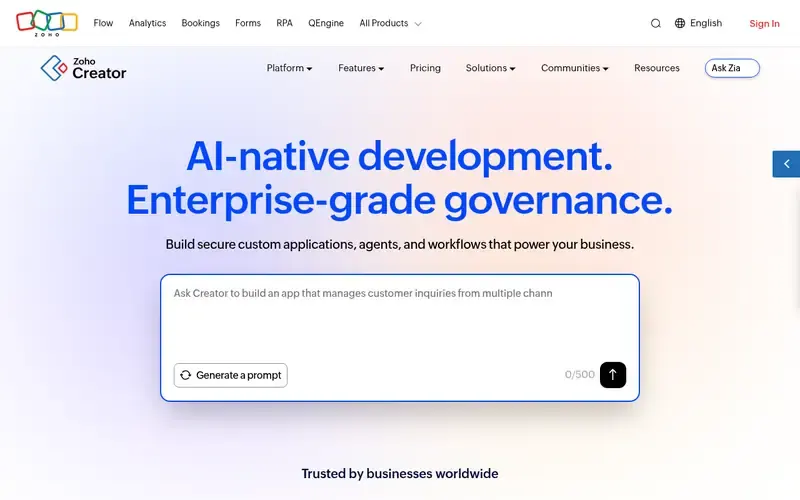
Zoho Creator is an AI app builder for building custom applications, agents and workflows. You can describe what you need to the Zia assistant, assemble ready-made components, or code with Deluge and VS Code.
Documented strengths
- Describe needs to Zia, or have Plan Agent turn an idea into a business requirement document
- Drag-and-drop web apps, with native iOS and Android apps generated automatically
- Portals for external users such as customers, vendors and partners
- More than 1,000 prebuilt connectors, including SAP and Oracle
- Built-in staging and production environments, backups and disaster recovery
Documented limits
The platform documents many options, including Deluge coding, several deployment targets and compliance certifications, so a small team should check which parts it actually needs. Pricing and plan details are on the vendor's own page.
- Who it is for
- Founders who want native mobile apps and customer portals from one platform
- Platforms
- Web, native iOS and Android; Zoho Cloud, AWS, Azure, GCP, on-premise or hybrid
- Pricing
- See the vendor's own pricing page for current plans and costs. zoho.com
- Facts checked
- 21 November 2026
Why it made the list: It sits fourth because it documents the widest range of build paths and deployment options, which gives flexibility but more to choose between for a first launch.

#5 · Quickbase Inc.
Quickbase
Process-heavy apps that need field-level permissions and separate environments
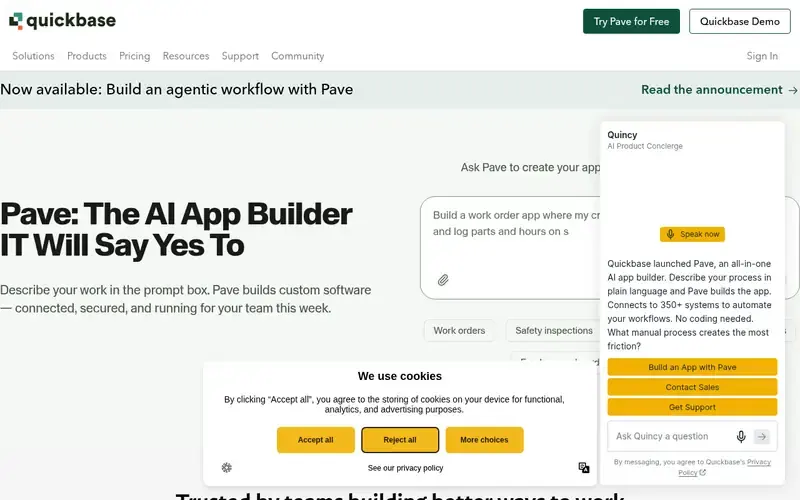
Quickbase is an application platform for dynamic work that brings data and teams into one place. It offers a no-code visual builder and Pave, an AI app builder that creates custom software from a prompt.
Documented strengths
- Pave creates custom software from a prompt
- No-code visual builder with template apps
- Permissions by role, down to the field level
- Separate dev, test and prod environments
- Mobile capabilities for field operations
Documented limits
Documented mainly for workflow and process handling across industries such as construction, manufacturing and government. Founders building a consumer-facing product should check the vendor documentation.
- Who it is for
- Process-heavy apps that need field-level permissions and separate environments
- Platforms
- Mobile capabilities stated; other platforms not stated on official pages
- Pricing
- See the vendor's own pricing page for current plans and costs. quickbase.com
- Facts checked
- 21 November 2026
Why it made the list: It closes the list because its documentation centers on workflow management, permissions and lifecycle controls for complex processes, which matter more once a product grows beyond a first version.
Side-by-side comparison
| Tool | Who it is for | Platforms | Pricing |
|---|---|---|---|
| SoftrSoftr | Client portals and internal tools built from a plain-language description | Vendor-managed hosting; apps built and edited visually, or described in Softr, Claude or ChatGPT | Pricing on softr.io |
| GlideGlide | Teams whose data already lives in spreadsheets | Desktop and phone apps; hosted on Google Cloud Platform with servers in Iowa, USA | Pricing on glideapps.com |
| AirtableAirtable Inc. | Data-heavy products that need a shared relational base | Not stated on official pages | Pricing on airtable.com |
| Zoho CreatorZoho Corporation | Founders who want native mobile apps and customer portals from one platform | Web, native iOS and Android; Zoho Cloud, AWS, Azure, GCP, on-premise or hybrid | Pricing on zoho.com |
| QuickbaseQuickbase Inc. | Process-heavy apps that need field-level permissions and separate environments | Mobile capabilities stated; other platforms not stated on official pages | Pricing on quickbase.com |
Choose by need
- Softr if you need client portals and internal tools built from a plain-language description.
- Glide if you need teams whose data already lives in spreadsheets.
- Airtable if you need data-heavy products that need a shared relational base.
- Zoho Creator if you need founders who want native mobile apps and customer portals from one platform.
- Quickbase if you need process-heavy apps that need field-level permissions and separate environments.
How this guide was built
We looked at how well each tool fits the job of getting a first usable app live without engineers: documented ways to create the data model, user logins and permissions, and workflow logic, and how much of that the vendor says can be done by describing it or assembling it visually. We also looked at what each vendor documents about hosting, deployment and platforms, because a founder needs to know where the app will run. We left out Budibase, which the vendor positions for enterprise IT teams rather than non-technical founders.
All facts come from official vendor pages, and we record the date each page was checked. The order reflects editorial fit for this use case: tools that document a short route from an idea or a spreadsheet to a working app come first, and platforms with broader scope and more configuration come later. It is not a statement that one tool is better overall. The list is built from vendor documentation rather than product trials, so check current capabilities with each vendor before you commit.
Order used: Ordered by how quickly a non-technical founder can ship a usable app with data, logins and workflows.
Common questions
Can a non-technical founder build an MVP with no-code tools?
The vendors on this list document no-code or prompt-based building. Softr generates a database, pages, user roles and logic from a description, and Glide builds an app from a spreadsheet. Check each vendor's documentation to confirm your specific app type is supported.
Which no-code builder works if my data is already in a spreadsheet?
Glide is documented for turning Excel and Google Sheets data into apps, and its SheetSense analyzes formulas and lookups. Softr and Airtable also document connections to external data, so compare them with your data setup.
Can I add user logins and permissions without coding?
Yes, according to the vendor pages. Softr documents role-based access with a preview as a specific role or user, Glide documents granular permissions, and Quickbase documents permissions down to the field level.
Which tools support customer or partner portals?
Softr is documented for portals, Zoho Creator documents portals for customers, vendors and partners, and Glide lists portals among typical apps. Confirm the details with each vendor.
Do any of these tools generate mobile apps?
Zoho Creator documents native iOS and Android apps generated automatically, and Glide documents apps for desktop and phone. Quickbase documents mobile capabilities for field operations.
Sources
- Softr: softr.io, softr.io/about (21 Nov 2026)
- Glide: glideapps.com, glideapps.com/security-center, glideapps.com/solutions/business (21 Nov 2026)
- Airtable: airtable.com, airtable.com/about, airtable.com/platform (21 Nov 2026)
- Zoho Creator: zoho.com/creator, zoho.com/creator/solutions, zoho.com/creator/solutions/asset-management (21 Nov 2026)
- Quickbase: quickbase.com, quickbase.com/product, quickbase.com/solutions (21 Nov 2026)
Related guides
- Top 6 low-code platforms for citizen developer programs with IT governance
- Top 6 no-code app builders for customer and partner portals
- Top 6 low-code platforms for professional developers building enterprise apps
- Top 6 no-code app builders for turning spreadsheets into internal tools
- More in No-code app builders
The editorial order is unpaid. A vendor may buy one labelled featured slot in a guide, but payment never alters another entry or removes a competitor. Featured entries get the same fact check. Logicwick is independent. Product names and trademarks belong to their respective owners.