The shortlist
For operations and admin teams that collect requests by form and need them routed and tracked, Nintex Process Platform, Pipefy and Kissflow are the closest fits on this shortlist. Each puts workflow logic behind the form instead of stopping at data collection. Zoho Creator, Airtable and Google Forms follow, covering teams that want an app builder, a shared database or a simple form as the starting point.
Tool details

#1 · Nintex
Nintex Process Platform
Governed, cross-system processes that start with a form
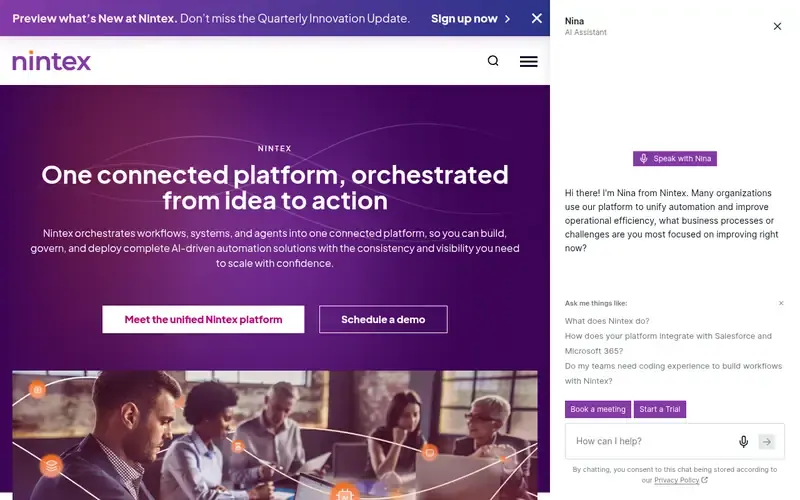
Nintex is a process management and workflow automation platform that brings workflows, forms, apps, documents, orchestration and AI agents together in one governed platform.
Documented strengths
- Forms, workflows, process mapping and document generation
- Orchestration of workflows, systems and agents in one platform
- Governance, permissions management and SSO authentication
- Built-in application lifecycle management from development to production
- Process intelligence embedded into orchestrated workflows
Documented limits
Documented for complex, governed processes across systems, so teams with a single simple request form may find it broader than needed. The official page does not detail approval routing patterns, so check the vendor documentation.
- Who it is for
- Governed, cross-system processes that start with a form
- Platforms
- Multi-tenant cloud (Nintex CE) or self-hosted on-premises (Nintex Automation K2)
- Pricing
- See the vendor's own pricing page for current plans and costs. nintex.com
- Facts checked
- 21 November 2026
Why it made the list: It sits first because forms, workflow, orchestration, process intelligence and governance are documented as parts of one platform, which gives the deepest routing and process logic behind a form.

#2 · Pipefy
Pipefy
Business teams without a dedicated technical team
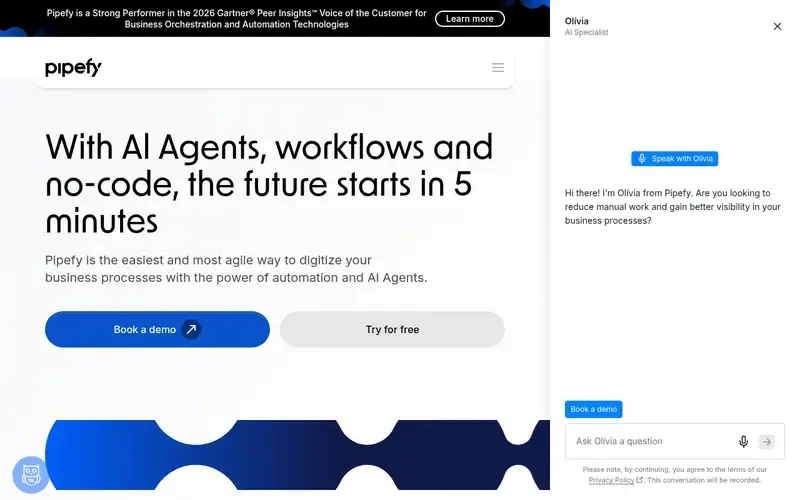
Pipefy is a no-code process orchestration platform that combines workflows, forms, portals, integrations and AI Agents to automate business processes.
Documented strengths
- Process orchestration through business rules, connected pipes and automations
- Forms and custom portals for customers, employees and vendors
- Requests created and tracked through Assistants or a chosen messaging channel
- WhatsApp, Teams and Slack integrated directly into workflows
- AI Builder that sets up a process from a natural-language description
Documented limits
The official page does not describe multi-step approval chains in detail, so teams with specific approval rules should check the vendor documentation. Self-hosted deployment is not stated.
- Who it is for
- Business teams without a dedicated technical team
- Platforms
- Operates on any LLM and cloud platform; integrates with ERPs, payroll and accounting software
- Pricing
- See the vendor's own pricing page for current plans and costs. pipefy.com
- Facts checked
- 21 November 2026
Why it made the list: It follows because process orchestration is defined through business rules, connected pipes and combined automations, with requests tracked through portals and messaging channels.

#3 · Kissflow Inc.
Kissflow
Mid-market and enterprise teams building approval workflows and portals
Kissflow is an AI-powered low-code and no-code platform for building custom enterprise apps and automating workflows.
Documented strengths
- Approval workflows, case management and external portals
- Conditional logic, decision tables, custom components and APIs
- Audit log that records every action and change
- Role-based access control and centralized governance
- Native connectors for major enterprise systems plus custom API integration
Documented limits
Documented for mid-market and enterprise organizations, so very small teams should check the vendor documentation for fit. Form-building specifics are not detailed on the official page.
- Who it is for
- Mid-market and enterprise teams building approval workflows and portals
- Platforms
- Public cloud, private cloud or region-specific infrastructure
- Pricing
- See the vendor's own pricing page for current plans and costs. kissflow.com
- Facts checked
- 21 November 2026
Why it made the list: It sits here because approval workflows are named among its documented uses, backed by conditional logic, decision tables and a full audit log.

#4 · Zoho Corporation
Zoho Creator
Teams building custom request apps with external portals
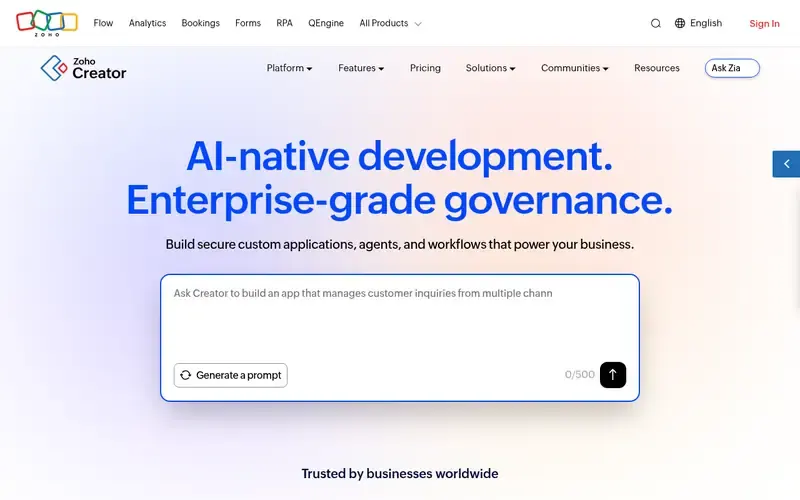
Zoho Creator is an AI app builder that helps businesses build custom applications, agents and workflows securely.
Documented strengths
- Apps built by prompting, with ready-made components, or by coding in Deluge
- Portals for external users such as customers, vendors and partners
- Over 1,000 prebuilt connectors to Zoho apps and third-party systems
- Built-in staging and production environments
- Multi-factor authentication, passkeys and single sign-on
Documented limits
It is documented as a general app builder, and the official page does not describe approval routing specifically. Teams that need approval chains should check the vendor documentation.
- Who it is for
- Teams building custom request apps with external portals
- Platforms
- Zoho Cloud, AWS, Azure, GCP, on-premise or hybrid; native iOS and Android apps generated automatically
- Pricing
- See the vendor's own pricing page for current plans and costs. zoho.com
- Facts checked
- 21 November 2026
Why it made the list: It fits when the form is one screen in a custom app, with portals for external users, many prebuilt connectors and staging and production environments.

#5 · Airtable Inc.
Airtable
Teams that want requests stored in a shared relational base
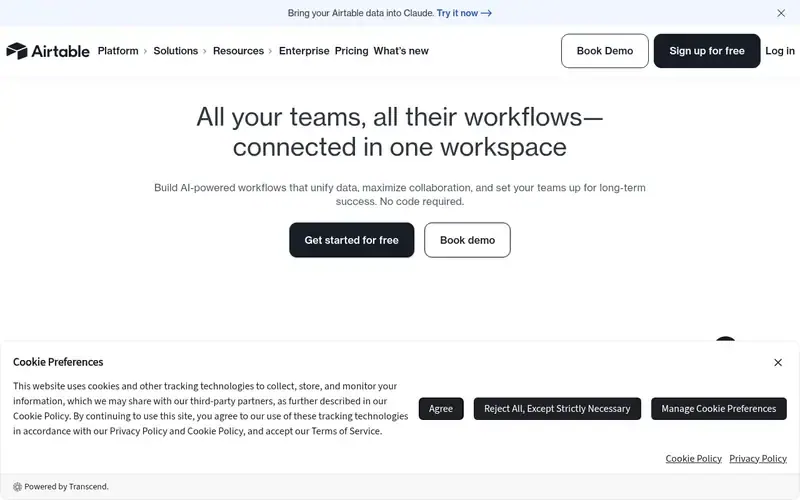
Airtable is a no-code platform for building AI-powered workflows, apps and agents on a shared relational data foundation.
Documented strengths
- No-code AI-powered workflows and conversational app building
- Admin roles and fine-grained role-based access control
- Audit logs covering both human and agent actions
- Data reachable from tools such as Slack, Claude, Salesforce and CMSs
- Apps packaged and shared across the organization with core structure locked
Documented limits
The official page focuses on workflows, apps and agents on shared data and does not describe form-driven approval routing. Teams that need that should check the vendor documentation.
- Who it is for
- Teams that want requests stored in a shared relational base
- Platforms
- Cloud; AI models run in Airtable's AWS environment, with European and Australian data residency supported
- Pricing
- See the vendor's own pricing page for current plans and costs. airtable.com
- Facts checked
- 21 November 2026
Why it made the list: It suits teams that want submissions to land in a shared relational database with permissions and an audit log, with workflow built around that data.

#6 · Google
Google Forms
Simple request intake and surveys
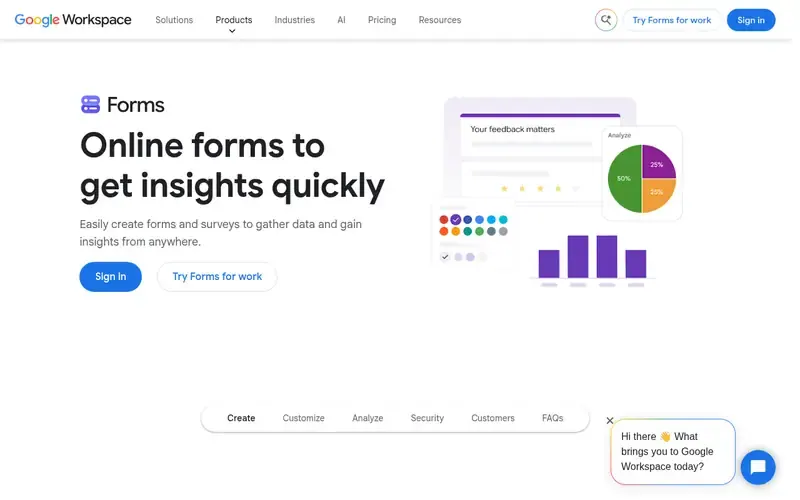
Google Forms is an online form and survey builder in Google Workspace for gathering data and insights.
Documented strengths
- Multiple question types with a drag-and-drop interface
- Conditional logic and quizzes
- Response data exported to Google Sheets
- Automated charts of responses in real time
- Collaboration on forms and results
Documented limits
Documented as a form and survey builder; the official page does not describe approval routing or tracking. Teams that need routed approvals should check the vendor documentation or pair it with a workflow tool.
- Who it is for
- Simple request intake and surveys
- Platforms
- Web-based in Google Workspace; respondents can fill out forms on any device
- Pricing
- See the vendor's own pricing page for current plans and costs. google.com
- Facts checked
- 22 November 2026
Why it made the list: It sits last because it covers collecting submissions well but documents no built-in routing or approval logic, which suits teams that only need intake or plan to pair it with another tool.
Side-by-side comparison
| Tool | Who it is for | Platforms | Pricing |
|---|---|---|---|
| Nintex Process PlatformNintex | Governed, cross-system processes that start with a form | Multi-tenant cloud (Nintex CE) or self-hosted on-premises (Nintex Automation K2) | Pricing on nintex.com |
| PipefyPipefy | Business teams without a dedicated technical team | Operates on any LLM and cloud platform; integrates with ERPs, payroll and accounting software | Pricing on pipefy.com |
| KissflowKissflow Inc. | Mid-market and enterprise teams building approval workflows and portals | Public cloud, private cloud or region-specific infrastructure | Pricing on kissflow.com |
| Zoho CreatorZoho Corporation | Teams building custom request apps with external portals | Zoho Cloud, AWS, Azure, GCP, on-premise or hybrid; native iOS and Android apps generated automatically | Pricing on zoho.com |
| AirtableAirtable Inc. | Teams that want requests stored in a shared relational base | Cloud; AI models run in Airtable's AWS environment, with European and Australian data residency supported | Pricing on airtable.com |
| Google FormsGoogle | Simple request intake and surveys | Web-based in Google Workspace; respondents can fill out forms on any device | Pricing on google.com |
Choose by need
- Nintex Process Platform if you need governed, cross-system processes that start with a form.
- Pipefy if you need business teams without a dedicated technical team.
- Kissflow if you need mid-market and enterprise teams building approval workflows and portals.
- Zoho Creator if you need teams building custom request apps with external portals.
- Airtable if you need teams that want requests stored in a shared relational base.
- Google Forms if you need simple request intake and surveys.
How this guide was built
We looked at how each tool connects a form to what happens next: documented workflow and routing capabilities, governance and audit features, integrations, and the deployment and platform options the vendor describes. The order reflects editorial fit for turning form submissions into routed, tracked approvals, with the deepest built-in routing and process logic behind the form first. It does not mean any tool is better overall, and a simpler tool can be the right choice for a simpler job.
All facts come from official vendor pages and are tied to the dates on which those pages were checked. This list is built from documentation rather than product trials, so it describes what each vendor states, not how a tool behaves in your environment. Where the documentation does not mention approvals or routing directly, we say so and suggest confirming details with the vendor.
Order used: Ordered by depth of built-in routing and approval logic behind the form, deepest first.
Common questions
What is the difference between a form tool and an approval workflow tool?
A form tool collects submissions, while an approval workflow tool also routes each submission to the right people and tracks its status. Nintex, Pipefy and Kissflow document workflow logic behind the form, while Google Forms is documented for collecting and analyzing responses.
Which tools on this list document approval workflows?
Kissflow names approval workflows among its enterprise uses. Nintex documents workflows, forms and orchestration in one platform, and Pipefy documents process orchestration through business rules and connected pipes.
Can external people such as customers or vendors submit requests?
Pipefy documents service portals for customers, employees and vendors. Zoho Creator documents portals for external users such as customers, vendors and partners, and Kissflow lists external portals among its uses.
Can Google Forms trigger approvals on its own?
The official page describes conditional logic, quizzes and export to Google Sheets, but does not describe approval routing. Teams that need approvals should check the vendor documentation or use a workflow tool alongside it.
Which tools offer audit trails for submitted requests?
Kissflow documents an audit log that records every action and change. Airtable documents audit logs covering human and agent actions, and Nintex lists governance and permissions management.
Sources
- Nintex Process Platform: nintex.com, nintex.com/platforms (21 Nov 2026)
- Pipefy: pipefy.com, pipefy.com/products, pipefy.com/about-us (21 Nov 2026)
- Kissflow: kissflow.com, kissflow.com/platform, kissflow.com/about-us (21 Nov 2026)
- Zoho Creator: zoho.com/creator, zoho.com/creator/solutions, zoho.com/creator/solutions/asset-management (21 Nov 2026)
- Airtable: airtable.com, airtable.com/about, airtable.com/platform (21 Nov 2026)
- Google Forms: workspace.google.com/products/forms, workspace.google.com/security, workspace.google.com/features (22 Nov 2026)
Related guides
The editorial order is unpaid. A vendor may buy one labelled featured slot in a guide, but payment never alters another entry or removes a competitor. Featured entries get the same fact check. Logicwick is independent. Product names and trademarks belong to their respective owners.