The shortlist
For fraud and financial crime work, this shortlist starts with Quantexa Decision Intelligence Platform, which connects fragmented data into relationships, followed by WorkFusion, whose AI agents handle AML, sanctions and KYC analyst work, and SAS Intelligent Decisioning, a governed decision-flow platform. It is written for compliance and fraud teams at financial institutions who need to decide which kind of tool fits their investigation workflow, from entity connections to alert handling to rules-based decisioning.
Tool details

#1 · Quantexa
Quantexa Decision Intelligence Platform
Connecting fragmented data for financial crime and fraud investigations
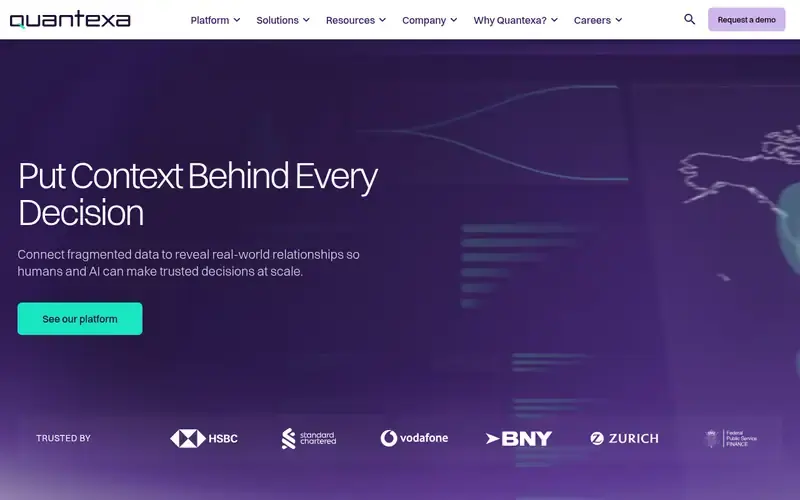
Quantexa's Decision Intelligence Platform connects fragmented data to reveal real-world relationships, so humans and AI can make contextual decisions at scale. It unifies siloed data sources into a single trusted foundation.
Documented strengths
- Connects fragmented data to reveal relationships
- Graph-powered contextual insights for analytical models
- Explainable and auditable AI applied to financial crime detection in banking
- Reusable data products to activate analytics and AI
- Can automate repeatable, low-risk decisions
Documented limits
Official pages describe the platform across banking, insurance, telecoms, healthcare and government, so teams should ask the vendor how it maps to their own AML or fraud case workflow. Deployment options are not stated on the pages we used.
- Who it is for
- Connecting fragmented data for financial crime and fraud investigations
- Platforms
- Not stated on official pages
- Pricing
- See the vendor's own pricing page for current plans and costs. quantexa.com
- Facts checked
- 21 November 2026
Why it made the list: It sits first because its documented use cases name financial crime, fraud and KYC directly, and its core idea of connecting scattered data points into one contextual view is what investigations depend on.

#2 · WorkFusion
WorkFusion
AML compliance teams scaling alert handling and KYC operations
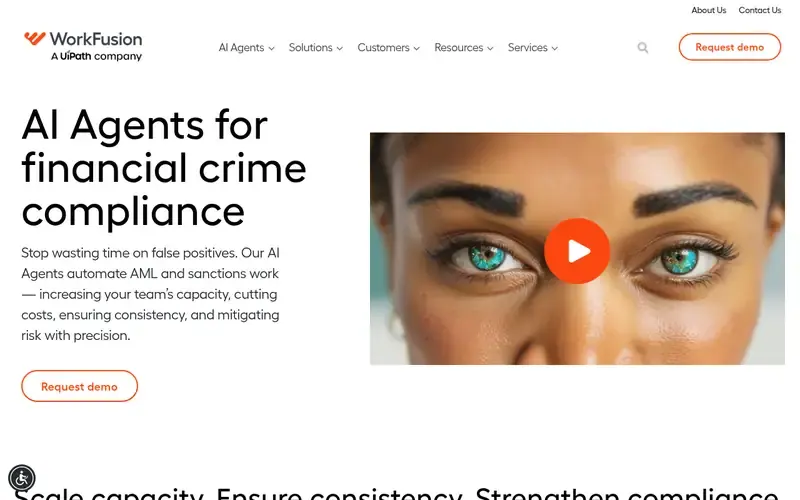
WorkFusion provides AI agents that act as digital analysts to automate anti-money laundering, sanctions screening and KYC work for financial institutions. The agents resolve alerts rather than only flagging them.
Documented strengths
- Takes on Level 1 alert reviews and Level 2 investigations
- Adjudications come with detailed narratives and audit trails for regulators
- Sanctions and name/PEP screening in line with BSA/OFAC requirements
- Kayla agent automates KYC and can move it from periodic to perpetual review
- Level-one handling of transaction monitoring alerts and real-time transaction screening
Documented limits
Documented for AML, sanctions and KYC alert work, not for building general decision flows or connecting data across systems. Teams with those needs should check the vendor documentation. The pages we used do not state platform or deployment details beyond SOC 2 certification.
- Who it is for
- AML compliance teams scaling alert handling and KYC operations
- Platforms
- Not stated on official pages
- Pricing
- See the vendor's own pricing page for current plans and costs. workfusion.com
- Facts checked
- 22 November 2026
Why it made the list: It follows Quantexa because it targets the day-to-day analyst workload in AML, covering Level 1 alert reviews and Level 2 investigations, rather than the data-connection layer underneath.

#3 · SAS Institute
SAS Intelligent Decisioning
Governed, auditable decision flows that mix models and rules
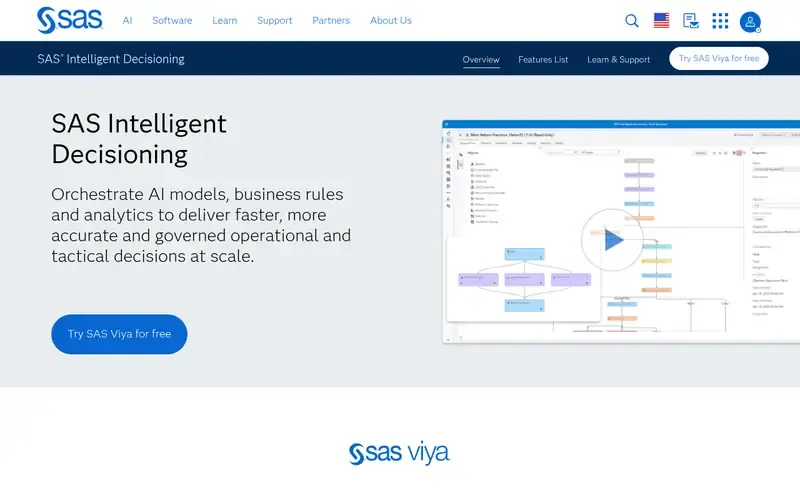
SAS Intelligent Decisioning is a cloud-native decision intelligence platform built on SAS Viya. It orchestrates AI models, business rules and analytics into governed decision flows.
Documented strengths
- Combines machine learning models, AI agents and deterministic business logic in one decision flow
- Version control, change tracking and role-based approvals across the decision life cycle
- Batch, API and real-time execution
- Drag-and-drop or code authoring, including Python and SAS
- SAS and Python models can run in OCI-compliant containers via SAS Container Runtime
Documented limits
Positioned for customer, risk, operational and tactical decisions across several industries, and the pages we used do not describe a fraud or AML case-management workflow. Teams that need one should check the vendor documentation.
- Who it is for
- Governed, auditable decision flows that mix models and rules
- Platforms
- Multiple clouds, hybrid and on-premises; SAS Viya can be SAS-managed or self-managed
- Pricing
- See the vendor's own pricing page for current plans and costs. sas.com
- Facts checked
- 21 November 2026
Why it made the list: It comes third because it is a general decisioning platform with strong governance, which suits teams building their own fraud and AML decision logic more than teams wanting a ready-made investigation workflow.

#4 · Rulex
Rulex Platform
Business and analyst teams building rule-based, explainable decision flows without code
rulex.aiRulex Platform is a no-code decision intelligence platform that combines explainable AI, optimization, business rules and scenario simulation. Teams use it to build, run and govern enterprise decisions.
Documented strengths
- Rulex Factory no-code environment for building decision flows
- Business rules written in plain English in spreadsheets
- If-then rules extracted from data with explainable AI
- Built-in Decision Governance
- Extracts information from unstructured sources such as PDFs, emails and web pages
Documented limits
Documented as a general decision platform with fraud detection as an example. Teams that need entity resolution or AML case handling should check the vendor documentation.
- Who it is for
- Business and analyst teams building rule-based, explainable decision flows without code
- Platforms
- Desktops to enterprise servers and containerized environments
- Pricing
- See the vendor's own pricing page for current plans and costs. rulex.ai
- Facts checked
- 21 November 2026
Why it made the list: It sits fourth because fraud detection is named only as one example use case, where if-then rules can be extracted from data with explainable AI, so it is a general toolkit rather than an investigation product.

#5 · IBM
IBM Operational Decision Manager
Rules-based decision automation with governance and audit documentation
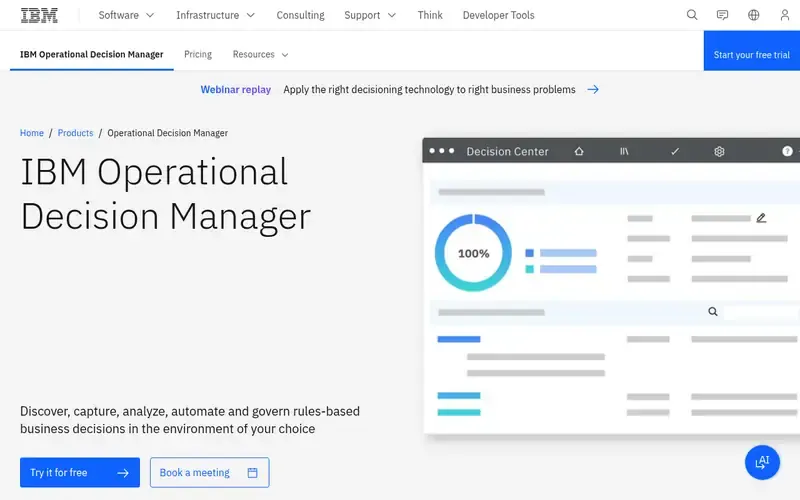
IBM Operational Decision Manager is a decision automation solution for discovering, capturing, analyzing, automating and governing rules-based decisions. It runs on premises or in the cloud.
Documented strengths
- Built-in testing and simulation to validate business logic against usage scenarios
- Documents how decisions were made to support auditing and compliance
- Role-based permissions for authoring, updating, deploying and managing rules
- Built-in governance and change management
- MCP servers can give AI agents access to governed business decisions
Documented limits
Documented for rules-based decision automation such as approvals, claims processing and onboarding, not for fraud or AML investigation. It is now available as part of IBM Decision Intelligence Enterprise Edition, so teams should check which offering applies to them.
- Who it is for
- Rules-based decision automation with governance and audit documentation
- Platforms
- On premises or cloud (SaaS); targets include OpenShift, Certified Kubernetes, app servers, embedded Java, compute grids and z/OS
- Pricing
- See the vendor's own pricing page for current plans and costs. ibm.com
- Facts checked
- 22 November 2026
Why it made the list: It closes the list because it is a rules-based decision engine with auditing and governance, with no documented fraud or AML investigation features, so it suits teams that already own the investigation workflow.
Side-by-side comparison
| Tool | Who it is for | Platforms | Pricing |
|---|---|---|---|
| Quantexa Decision Intelligence PlatformQuantexa | Connecting fragmented data for financial crime and fraud investigations | Not stated on official pages | Pricing on quantexa.com |
| WorkFusionWorkFusion | AML compliance teams scaling alert handling and KYC operations | Not stated on official pages | Pricing on workfusion.com |
| SAS Intelligent DecisioningSAS Institute | Governed, auditable decision flows that mix models and rules | Multiple clouds, hybrid and on-premises; SAS Viya can be SAS-managed or self-managed | Pricing on sas.com |
| Rulex PlatformRulex | Business and analyst teams building rule-based, explainable decision flows without code | Desktops to enterprise servers and containerized environments | Pricing on rulex.ai |
| IBM Operational Decision ManagerIBM | Rules-based decision automation with governance and audit documentation | On premises or cloud (SaaS); targets include OpenShift, Certified Kubernetes, app servers, embedded Java, compute grids and z/OS | Pricing on ibm.com |
Choose by need
- Quantexa Decision Intelligence Platform if you need connecting fragmented data for financial crime and fraud investigations.
- WorkFusion if you need aML compliance teams scaling alert handling and KYC operations.
- SAS Intelligent Decisioning if you need governed, auditable decision flows that mix models and rules.
- Rulex Platform if you need business and analyst teams building rule-based, explainable decision flows without code.
- IBM Operational Decision Manager if you need rules-based decision automation with governance and audit documentation.
How this guide was built
We looked at three things: fit with fraud and AML investigation workflows, the capabilities each vendor documents, and the deployment and platform options described on official pages. Tools that speak directly to financial crime, KYC or alert handling sit earlier. Tools that offer general decisioning, which a team would then shape into its own fraud logic, sit later.
All facts come from official vendor pages, and we record the date each page was checked. The order reflects editorial fit for this use case, as explained in each entry, and does not say one tool is better overall. The list is built from vendor documentation rather than product trials, so teams should confirm details with each vendor before shortlisting.
Pricing is not covered here. Each tool's page links to the vendor's own pricing information.
Order used: Ordered by direct fit for fraud and AML investigation workflows, then by general decisioning strength.
Common questions
What is decision intelligence for fraud and financial crime?
Vendors use the term for platforms that combine data, analytics, AI and business rules to support decisions. Quantexa, for example, connects fragmented data to reveal relationships for human and AI decisions, with explainable AI applied to financial crime detection in banking.
Which tools here are built for AML alert handling?
WorkFusion is the most direct fit. Its AI agents take on Level 1 alert reviews and Level 2 investigations, and adjudications come with narratives and audit trails for regulators.
Can these tools support audit and explainability requirements?
Several document it. Quantexa emphasizes explainable and auditable AI, SAS includes role-based approvals and governance workflows, and IBM Operational Decision Manager documents how decisions were made. Teams should confirm specifics with each vendor.
Which tools offer flexible deployment?
SAS Intelligent Decisioning documents multiple clouds, hybrid and on-premises deployment. Rulex ranges from desktops to containerized environments, and IBM Operational Decision Manager runs on premises or in the cloud.
Do Rulex and IBM Operational Decision Manager handle fraud investigations out of the box?
The pages we used do not describe an investigation workflow for either. Rulex names fraud detection as an example use case for extracting rules from data, and IBM documents general rules-based decision automation.
Sources
- Quantexa Decision Intelligence Platform: quantexa.com, quantexa.com/about (21 Nov 2026)
- WorkFusion: workfusion.com, workfusion.com/solutions, workfusion.com/solutions/know-your-customer (22 Nov 2026)
- SAS Intelligent Decisioning: sas.com/en_us/software/intelligent-decisioning.html, sas.com/en_us/solutions/ai.html (21 Nov 2026)
- Rulex Platform: rulex.ai, rulex.ai/about-us, rulex.ai/rulex-platform (21 Nov 2026)
- IBM Operational Decision Manager: ibm.com/products/operational-decision-manager, ibm.com/products, ibm.com/solutions/decision-intelligence (22 Nov 2026)
Related guides
The editorial order is unpaid. A vendor may buy one labelled featured slot in a guide, but payment never alters another entry or removes a competitor. Featured entries get the same fact check. Logicwick is independent. Product names and trademarks belong to their respective owners.